

Google Gemini
Google's AI for writing, planning, and brainstorming
CodingPersonal assistant
Released May 16
Freemium · From $0
610

Reviewed by Shawn H. — Founder, AITrustList
Last verified MethodologyAI tools are ranked by traffic signals, not paid placement.

Open AI coding agent across VS Code, JetBrains,CLI and Cloud
Kilo Code is an open-source AI coding agent that runs in VS Code, JetBrains, CLI, and the cloud, with access to 500+ models and zero inference markup.
Independently written by the AITrustList editorial team.
+1 more pro not shown
Other products in the same task, ranked by popularity.
Pricing and commercial details available on the current listing.
What it is, how to use it, and the full listing description.
Kilo Code is an open-source AI coding agent that integrates directly into editors, terminals, and cloud workflows to write, refactor, debug, and review code.
Install the Kilo extension in VS Code or JetBrains, install the CLI, or sign in at app.kilo.ai to launch Cloud Agents. Pick a mode (Code, Architect, Debug, Ask, or Custom), choose Efficient, Frontier, Free, or your own model key, and start prompting against your codebase.
Kilo Code is an open-source AI coding agent built to work where developers already work. A single agent runs across VS Code, JetBrains IDEs (IntelliJ, PyCharm, WebStorm), a terminal CLI, and cloud environments, with optional Slack and mobile workflows.
The agent supports 500+ LLMs, including open-weight and frontier options, and routes between Efficient, Frontier, and Free tiers automatically via Auto Model. Users can bring their own provider keys at zero markup, run local models, or pay per token through the Kilo Gateway. Specialized modes cover Code, Architect, Debug, Ask, and Custom tasks, with parallel isolated worktrees and shared context.
Cloud Agents extend the same agent into scheduled, webhook-triggered, and remote execution flows, alongside a Code Reviewer and Security Agent. The codebase itself is MIT-licensed and publicly hosted on GitHub (Kilo-Org/kilocode), so prompts, context handling, and routing decisions are fully inspectable.
Kilo Code is used by 5M+ developers and processes 10T+ tokens per month. A free Auto tier is available with no credit card, and paid plans (including Kilo Pass) unlock higher usage. The product is developed by Kilo Code, Inc., based in Amsterdam, and has been acquired by Anaconda.
Traffic and engagement metrics for kilo.ai.
Kilo Code traffic grew by 27284.3% over the last 12 months, reaching 1.0M monthly visits. It is currently tracked in the Coding category on AITrustList.
| Keyword | Traffic | Cost Per Click |
|---|---|---|
| kilo code | 78.9K | $ 2.31 |
| kilocode | 19.9K | $ 2.78 |
| kilo | 27.7K | $ 0.21 |
| kilo cli | 4.0K | $ 5.62 |
| cursor | 2.3M | $ 3.02 |
0.00 out of 5
Based on 0 reviews
No published reviews yet.
Questions and answers included with this listing.
Kilo Code is an open-source AI coding agent that runs in editors like VS Code and JetBrains, in a CLI, and in cloud environments, supporting 500+ models.
Yes. A free Auto tier is available with no credit card required, and paid plans such as Kilo Pass unlock higher usage.
Kilo supports VS Code, JetBrains IDEs (IntelliJ, PyCharm, WebStorm), a CLI, cloud agents, Slack, and a mobile app.
Yes. The agent is MIT-licensed and its source code is publicly available on GitHub at Kilo-Org/kilocode.
Yes. Kilo supports bring-your-own-key access to providers with no inference markup, in addition to local models and paid gateway usage.
Official and listing-specific external resources.
Published tools in the same task branch.
Google's AI for writing, planning, and brainstorming
Released May 16
Freemium · From $0

GLM-5 AI assistant for chat, writing, and programming.

Released May 25
Freemium

AI assistant for problem solving, coding, and data analysis

Released May 17
Paid

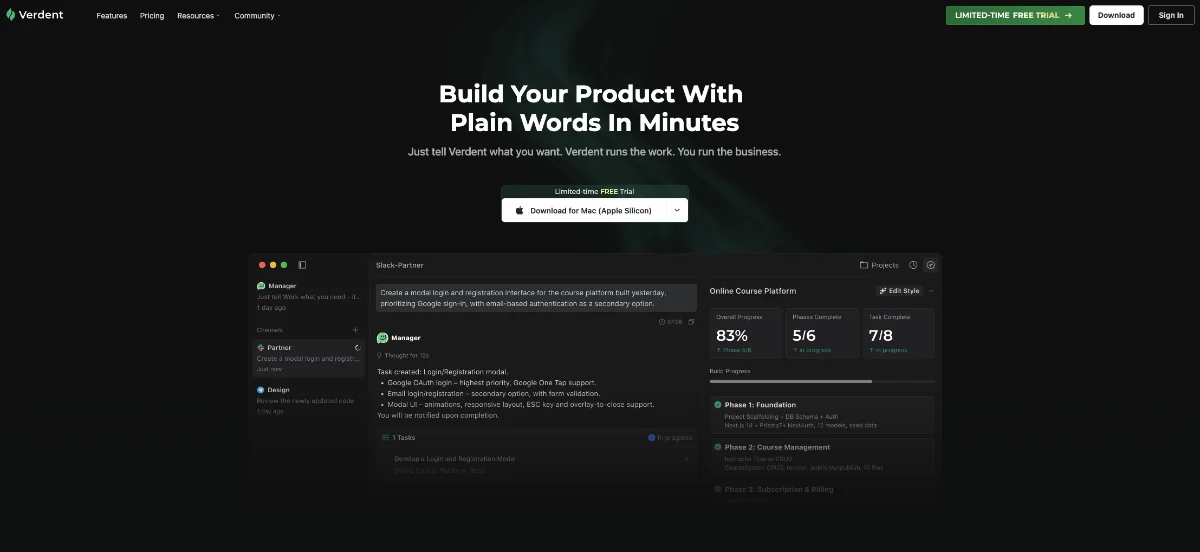
Agentic coding suite with parallel agents and Plan Mode
Released May 25
Free Trial · From $ 19 /month