
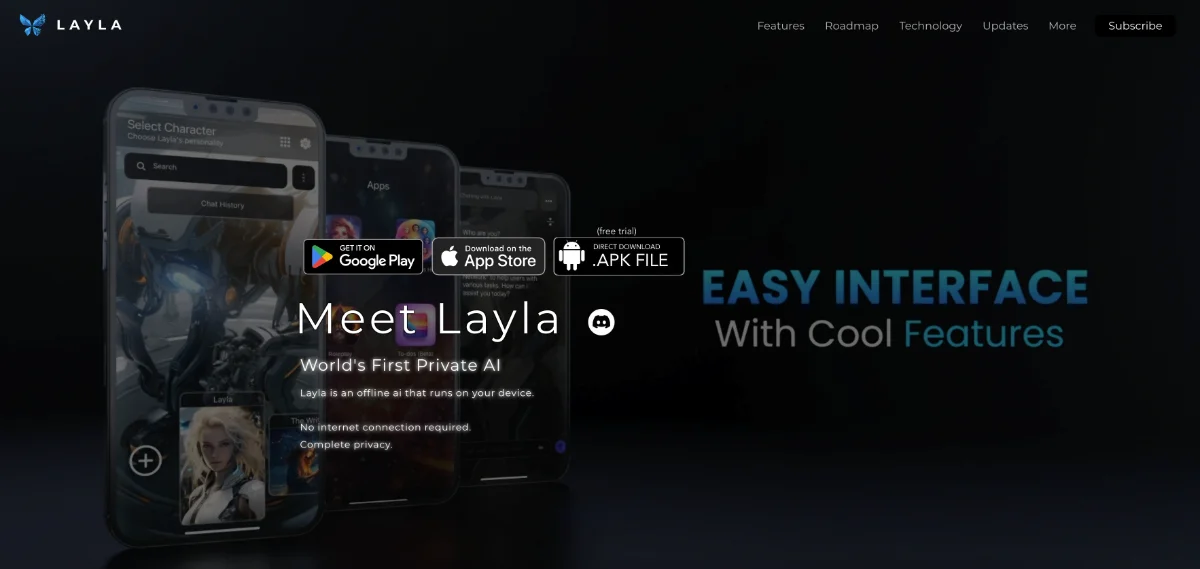
Layla
Your personal AI assistant running entirely on-device
Personal assistantSmall/Edge Models
Released Jun 24
One-time
430

Reviewed by Shawn H. — Founder, AITrustList
Last verified MethodologyAI tools are ranked by traffic signals, not paid placement.

Multiplayer AI workspace where teams and agents collaborate
Dust is a multiplayer AI platform where humans and AI agents collaborate as co-contributors, sharing knowledge, tools, and workflows.

Independently written by the AITrustList editorial team.
+1 more pro not shown
Other products in the same task, ranked by popularity.
Pricing and commercial details available on the current listing.
What it is, how to use it, and the full listing description.
Dust is a multiplayer AI workspace where people and AI agents work together as equal co-contributors on shared knowledge, tools, and workflows.
Sign up for free, connect your tools and data sources, configure or build AI agents, then invite teammates to collaborate on shared conversations and automated workflows.
Dust is a multiplayer AI workspace designed for human-agent collaboration. Instead of single-player AI tools, Dust gives entire teams and their AI agents shared access to the same knowledge, tools, conversations, and notifications so work compounds across the organization.
The platform connects to a company's existing stack via 100+ production connectors and adds a semantic knowledge layer that synthesizes information rather than just retrieving it. Agents built on Dust are self-improving: best practices consolidate into reusable skills and improvements spread automatically across teams.
Dust supports model flexibility across OpenAI, Anthropic, Google, and Mistral, and ships with enterprise-grade security including SOC 2 Type II, GDPR, EU data residency, HIPAA-ready deployment, SSO/SAML/OIDC, SCIM, and a dual-layer permission model that separates agent access from user access. REST APIs, MCP, webhooks, OAuth2, and bi-directional sync support custom integrations.
Teams in engineering, customer support, sales, marketing, data, and operations use Dust for use cases like AI-powered code debugging, automated code reviews, incident response runbooks, continuous doc generation, ticket triage and CRM updates, and internal knowledge search. Dust reports 300,000+ agents deployed and 3,000+ teams running on the platform, with customers including Datadog, Clay, Cursor, Decagon, 1Password, Vanta, and Watershed.
Traffic and engagement metrics for dust.tt.
Dust had 491.2K monthly visits in the latest recorded month. It is currently tracked in the Knowledge category on AITrustList.
| Keyword | Traffic | Cost Per Click |
|---|---|---|
| dust | 67.7K | $ 1.43 |
| dust ai | 8.2K | $ 5.24 |
| dustt | 1.8K | $ 2.30 |
| dust tt | 790 | $ 5.17 |
| how to create a pod in dust agent | 610 | -- |
0.00 out of 5
Based on 0 reviews
No published reviews yet.
Questions and answers included with this listing.
Dust is a multiplayer AI workspace where people and AI agents collaborate as co-contributors, sharing knowledge, tools, conversations, and notifications.
Dust offers model flexibility across frontier providers including OpenAI, Anthropic, Google, and Mistral.
Dust is SOC 2 Type II certified, GDPR compliant with EU data residency, HIPAA-ready, and supports SSO (SAML, OIDC), SCIM, audit logs with 365-day retention, RBAC, dual-layer agent permissions, AES-256 encryption at rest, and TLS 1.3 in transit.
Dust ships with 100+ production connectors, plus a RESTful API, MCP for proprietary systems, webhooks, and OAuth2 for custom integrations with bi-directional sync.
Official and listing-specific external resources.
Published tools in the same task branch.
Your personal AI assistant running entirely on-device
Released Jun 24
One-time

Grok Bot – AI Agents That Work Across Your Apps and Tools
Released Aug 22
Freemium

AI documentation platform for developers and enterprises
Released May 20
Freemium