Shawn H. avatar

Reviewed by Shawn H. — Founder, AITrustList

Last verified MethodologyAI tools are ranked by traffic signals, not paid placement.

Composio logo

Composio

Just-in-time tool calls and secure auth for AI agents

AI AgentsTask automationWorkspace organization+1
FreemiumVerified Aug 5, 2026

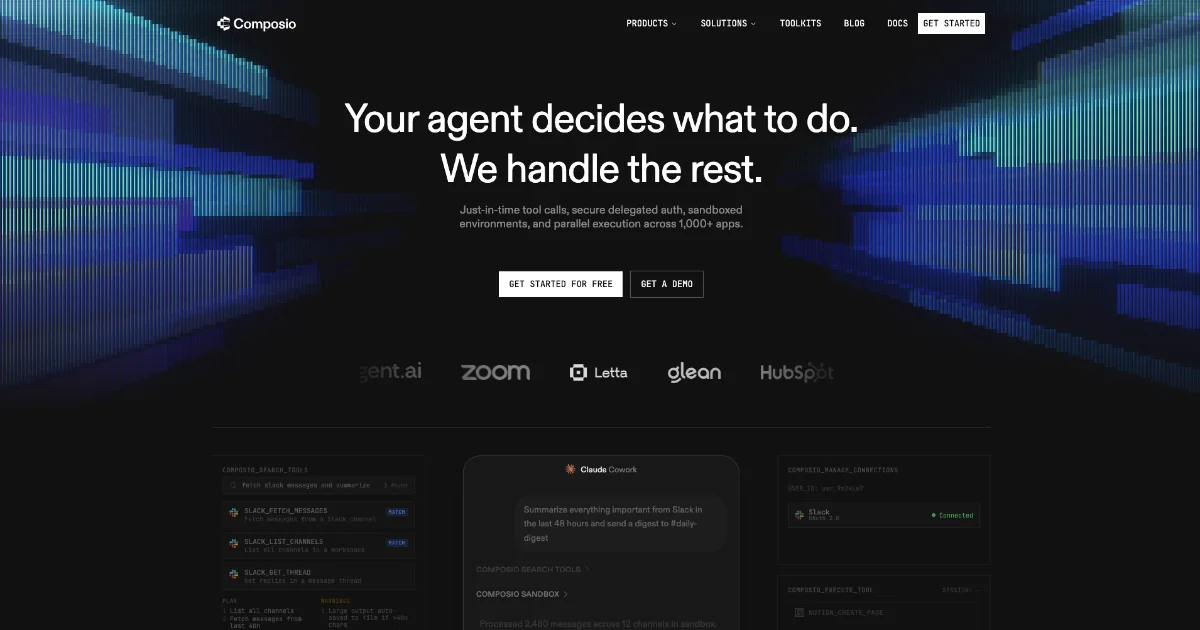
Connect AI agents to 1,000+ apps with managed OAuth, sandboxed execution, and parallel tool calls.

Composio alternatives
Screenshot 1

Pros & cons

Independently written by the AITrustList editorial team.

Pros

  • Free tier available with no upfront cost
  • Integrates with 1,000+ external apps
  • Managed OAuth handles auth automatically
  • Sandboxed execution environment included
  • Parallel tool calls supported for agents

Cons

  • Paid plan needed beyond free tier limits
  • Dependent on third-party API uptime
  • Vendor lock-in via managed OAuth layer
  • Usage-based pricing scales with volume
  • Free tier has restricted execution quotas

Composio alternatives

More Composio alternatives

Other products in the same task, ranked by popularity.

Composio Pricing

Pricing and commercial details available on the current listing.

Pricing model
Freemium
Starting price
Free

About Composio

What it is, how to use it, and the full listing description.

What is Composio?

Composio is an agent infrastructure platform that lets AI agents call tools across 1,000+ apps with managed auth, sandboxed execution, and intent-based tool routing.

How to use Composio?

Sign in to the Composio dashboard, connect the apps you want your agent to use, then call session.tools() in your code to get a curated, intent-resolved toolset. The platform handles OAuth, token refresh, and sandboxed execution so you can focus on agent logic.

Core features of Composio

  • Managed OAuth and token lifecycle for 1,000+ app integrations
  • Just-in-time tool resolution by intent with built-in guardrails
  • Ephemeral, remote sandboxes for parallel tool execution
  • Context-aware sessions that carry state, files, and progress
  • Triggers for bidirectional communication with connected apps
  • Model- and framework-agnostic SDK (Claude, GPT, Gemini, Cursor, etc.)

Target audience of Composio

AI DevelopersDevelopersMarketersProject ManagersResearchers

Use cases of Composio

  • #1Triaging Sentry errors and creating Linear tickets automatically
  • #2Drafting and sending emails via Gmail from an agent workflow
  • #3Summarizing Slack channels and posting digests to Notion
  • #4Creating GitHub pull requests and posting engineering updates
  • #5Exporting SQL query results from Supabase into Google Sheets

Composio is a developer platform and runtime for giving AI agents real-world capabilities. It connects agents to 1,000+ external apps through managed authentication and just-in-time tool resolution, so an agent only sees the right tools at the right time instead of a static, bloated toolbox.

The platform handles the full tool-calling stack: OAuth, API keys, token refresh, connection lifecycle, and per-user authorization. Tools are resolved by intent with built-in guardrails, and accuracy improves through account-level optimization based on real-world usage. Each session is context-aware, carrying sandbox state, files, and progress so agents do not start from scratch.

Composio provides ephemeral, remote sandboxes where tools run as code, with large responses stored on a navigable filesystem. It supports parallel execution and triggers for bidirectional communication with connected apps. The SDK and platform are model- and framework-agnostic, working with Claude, GPT, Gemini, Cursor, and other agent frameworks without lock-in.

Enterprise features include fine-grained data access controls, SOC 2 and ISO 27001:2022 compliance, and bring-your-own-cloud deployment. A CLI and managed MCP gateway extend the platform for terminal workflows and tool routing.


Composio Website Traffic Analysis

Traffic and engagement metrics for composio.dev.

Visit Over Time

Composio traffic grew by 428.9% over the last 12 months, reaching 2.3M monthly visits. It is currently tracked in the AI Agents category on AITrustList.

Monthly Visits2.3M
Avg. Visit Duration03:53
Page per Visit4.67
Bounce Rate39.73%
Oct 2025 - Sep 2026 All Traffic

Geography

Top 5 Regions

📍United States
26.90%
📍India
8.46%
📍Brazil
5.02%
📍United Kingdom
4.15%
📍Germany
2.89%
Oct 2025 - Sep 2026 Desktop Only

Traffic Sources

Direct
42.74%
Organic Search
41.54%
Referrals
5.92%
Organic Social
4.02%
GenAI
3.10%
Mail
1.13%
Display Ads
0.97%
Paid Search
0.50%
Paid Social
0.08%
Affiliate
0.00%
Oct 2025 - Sep 2026 Worldwide Desktop Only

AI Referral Traffic

ChatGPT
82.3%
Google Gemini
9.2%
Perplexity AI
7.5%
Oct 2025 - Sep 2026 AI Engine Share Trends

Top Keywords

KeywordTrafficCost Per Click
composio317.2K$ 1.39
composio mcp7.1K$ 10.60
composio for you13.7K$ 10.43
composio login3.9K--
composio ai7.0K$ 2.78

Customer Reviews

☆☆☆☆☆

0.00 out of 5

Based on 0 reviews

★★★★★
0
★★★★☆
0
★★★☆☆
0
★★☆☆☆
0
★☆☆☆☆
0

No published reviews yet.

FAQ from Composio

Questions and answers included with this listing.

What is Composio?

Composio is an agent infrastructure platform that provides just-in-time tool calls, secure delegated auth, sandboxed environments, and parallel execution across 1,000+ apps.

Which models and frameworks does Composio support?

Composio is model- and framework-agnostic, working with providers like Anthropic Claude, OpenAI, and Google Gemini, and integrating with environments such as Claude Code, Cursor, and other MCP clients.

How does Composio handle authentication?

Composio manages OAuth, API keys, token refresh, and connection lifecycle end-to-end. Auth is triggered inline by user intent and scoped to exactly what the agent needs.

What security and compliance certifications does Composio have?

Composio is SOC 2 and ISO 27001:2022 certified, offers fine-grained data access controls, and supports bring-your-own-cloud deployments for enterprise customers.

Can I try Composio for free?

Yes. The site offers a 'Get started for free' option via the Composio dashboard, alongside enterprise plans with governance, SSO, and org-wide controls.